
Invoices and getting paid
Bill a job, email your client a link they can pay by card, and have the payment recorded against the invoice without you touching it.
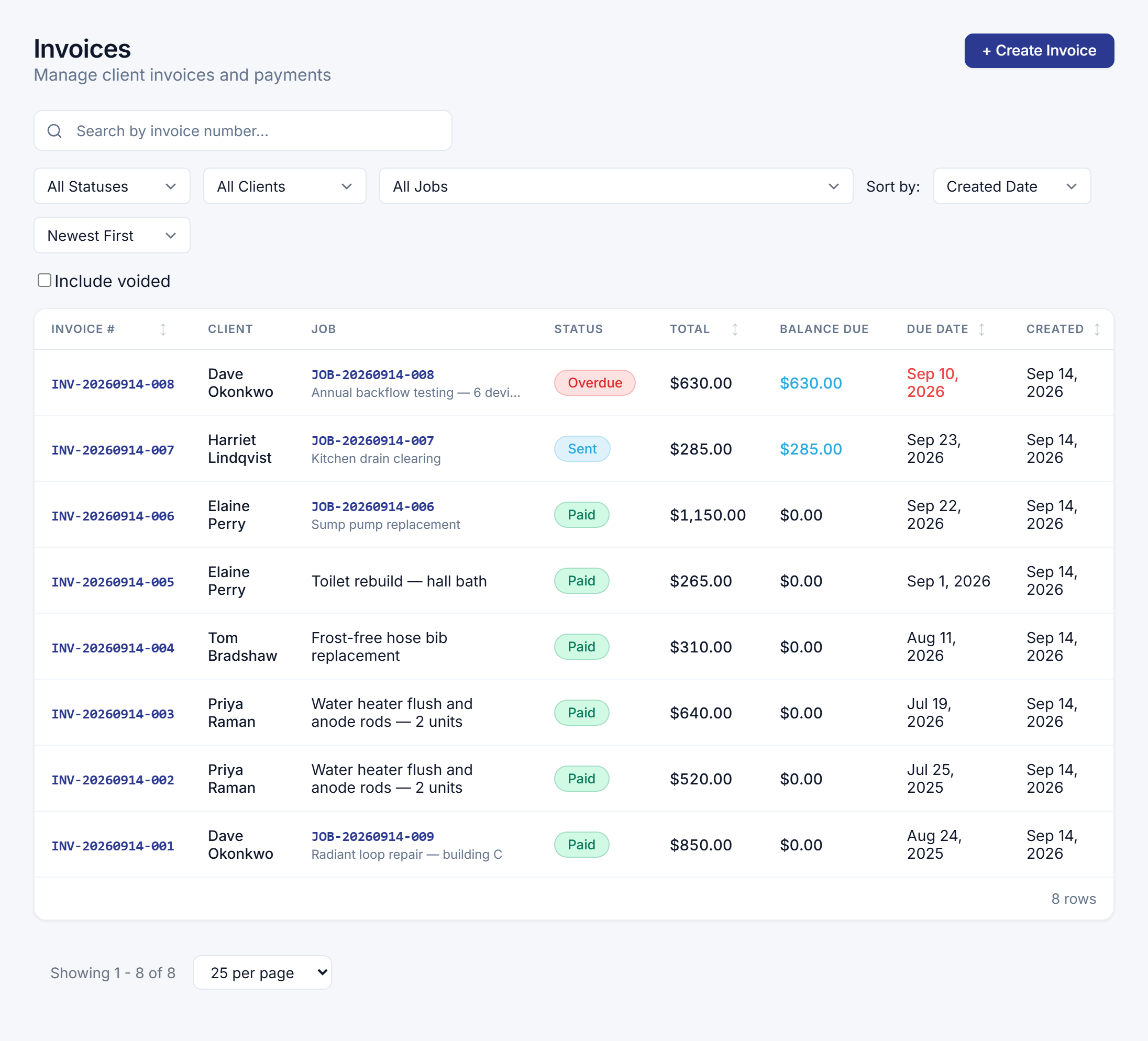
An invoice is how the work turns into money. You build it from the job, send your client a link, and they pay by card without signing in to anything — the payment lands against the invoice on its own.
Build an invoice
Open Invoices and add one, or start from the job so the client and the work come with it.
Each line can be one of three shapes, and picking the right one saves you doing arithmetic:
- A fixed amount — a flat price for the thing.
- Quantity × unit price — 12 fixtures at $45.
- Hours × hourly rate — 6.5 hours at $95.
Drag lines to reorder them. The subtotal, tax and total add themselves up as you go.
Follow an invoice through to paid
| Status | What it means |
|---|---|
| Draft | Yours to edit freely. Nobody has seen it. |
| Sent | Emailed to your client. |
| Viewed | Your client has opened the link. |
| Partially paid | Some money has come in, with a balance still owed. |
| Paid | The balance is zero. |
| Void | Canceled. The record stays. |
A draft is fully editable. Once an invoice has been sent, what you can change is limited — an invoice somebody is looking at should not move under them.
Send it to your client
The Send to client panel at the top of an invoice holds everything about getting it out, beside the state of the link itself:
- Email to client — sends the invoice with a pay button.
- Mark as sent — for when you handed it over some other way.
- Send again — resends, and updates when it was sent.
- Revoke link — kills the link if it went to the wrong place.
The payment reminder for something overdue sits in the invoice header, separate from the send panel, because chasing is a different act from sending.
Your client opens the link with no account and no password, sees the invoice and its payment history, and can pay from there.
Take payment by card
Your client presses Pay and is taken to a secure checkout. When the payment succeeds it is recorded against the invoice automatically — you do not reconcile anything.
Two things worth knowing about how the money moves:
- Your business is the merchant. The charge settles to your connected account, and your client’s card statement reads your business’s name rather than ours.
- Fees come out of your side, never added to your client’s bill. Your client is charged the invoice amount. The platform fee and card processing are deducted from what reaches you.
The one thing that can make the charge larger than the invoice is a tip your customer chose to add — see Tips. It rides along on the same payment, carries no platform fee, and never touches the invoice’s balance.
Partial payments are fine. An invoice can take several payments until the balance reaches zero.
Record a payment that came in some other way
Cash, a check, a bank transfer — record it against the invoice and it counts exactly like a card payment. The amount cannot be more than the balance owed, which catches the common typo before it becomes a reconciliation problem.
A payment recorded by mistake is voided with a reason rather than deleted, so the invoice’s history still explains itself.
Handle a chargeback
If a client’s bank disputes a card payment, the disputed amount is taken back from your balance while the bank decides. The product does four things at that point:
- Marks the payment Disputed, with the bank’s stated reason.
- Shows you the deadline for sending evidence.
- Tells you what evidence to send.
- Leaves the invoice reading as paid while it is being decided, because it is not yet unpaid.
If you win, the money comes back and the payment stands. If you lose, the payment is voided and the invoice shows the balance owed again.
Send a PDF instead
Every invoice downloads as a PDF with your logo, the line items and the totals, laid out for paper. Some clients want a document for their records or their accountant, and the link is not always the answer.
Void an invoice
Voiding is a soft delete — the invoice is canceled and the record stays, which is what you need when somebody asks six months later what happened to invoice 41. Voiding can be undone.
This page describes Invoice & Payments - Documentation. It is written from that feature’s record and covers what has shipped, never what is planned.