
Keeping the account secure
See every device signed in, get told when a new one appears, and require everybody in the business to use a second factor.
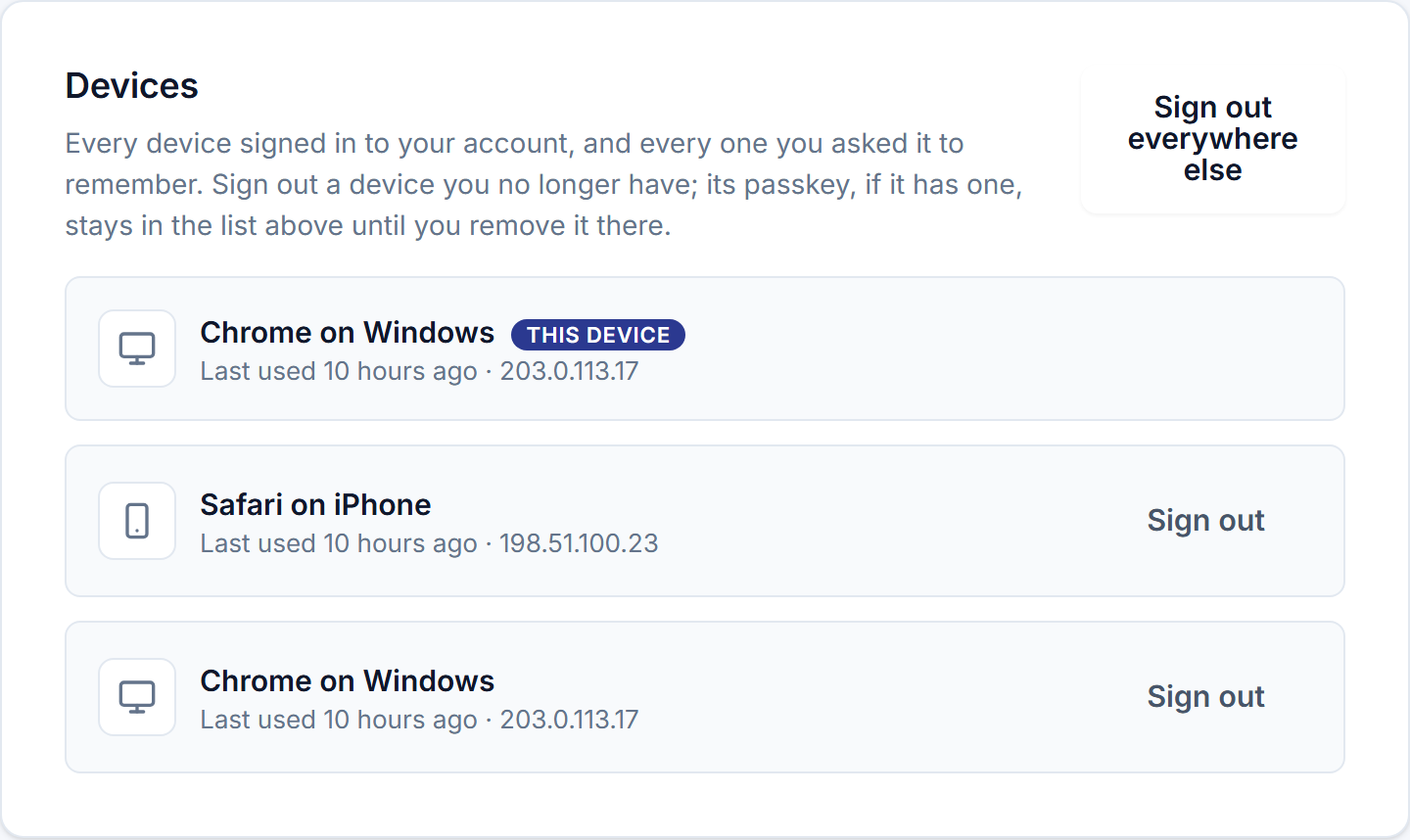
Once more than one person signs in to your business, three questions come up: where am I signed in, would I know if somebody else was, and can I make everybody use a second factor. This is the answer to all three.
See where you are signed in
Your Security page lists every device holding a session — the office computer, your phone, the tablet left in the van — with when each was last used.
Sign out one of them, or sign out everything else at once.
A lost phone is a row to remove, not a password to change. That is the point of this list: the narrow, immediate fix, without disrupting everybody else.
Get told when a new device signs in
The moment your account signs in from a device it has not seen before, you get an email: when it happened, roughly where from, on what, and what to do if it was not you.
There is nothing to configure. It is on, for every account, always — because it is the one warning a compromised account gets while there is still time to act on it.
Require a second factor across the business
An owner can require that everyone in this business signs in with a second factor, or the stronger version: with an authenticator app or a passkey.
Somebody who has not met the requirement signs in and reaches a wall that opens their Security page and nothing else, until they have set one up. They are not locked out; they are pointed at the one thing they need to do.
The owner can see who has met the requirement and who has not, so it is a list to work through rather than a policy you hope took effect.
What to do if something looks wrong
If you get a new-device email you do not recognize:
- Sign out everything else from your Security page.
- Change your password.
- Turn on a second factor if you had not already — see Signing in.
In that order. Signing the other sessions out first stops whoever it was from continuing while you do the rest.
This page describes Sign-In Security — Signed-In Devices, New-Device Alerts and an Org-Wide Requirement. It is written from that feature’s record and covers what has shipped, never what is planned.