
Job costing and margins
Price work from real labor rates and reusable templates, then watch the estimate against what the job is actually costing while it is still running.
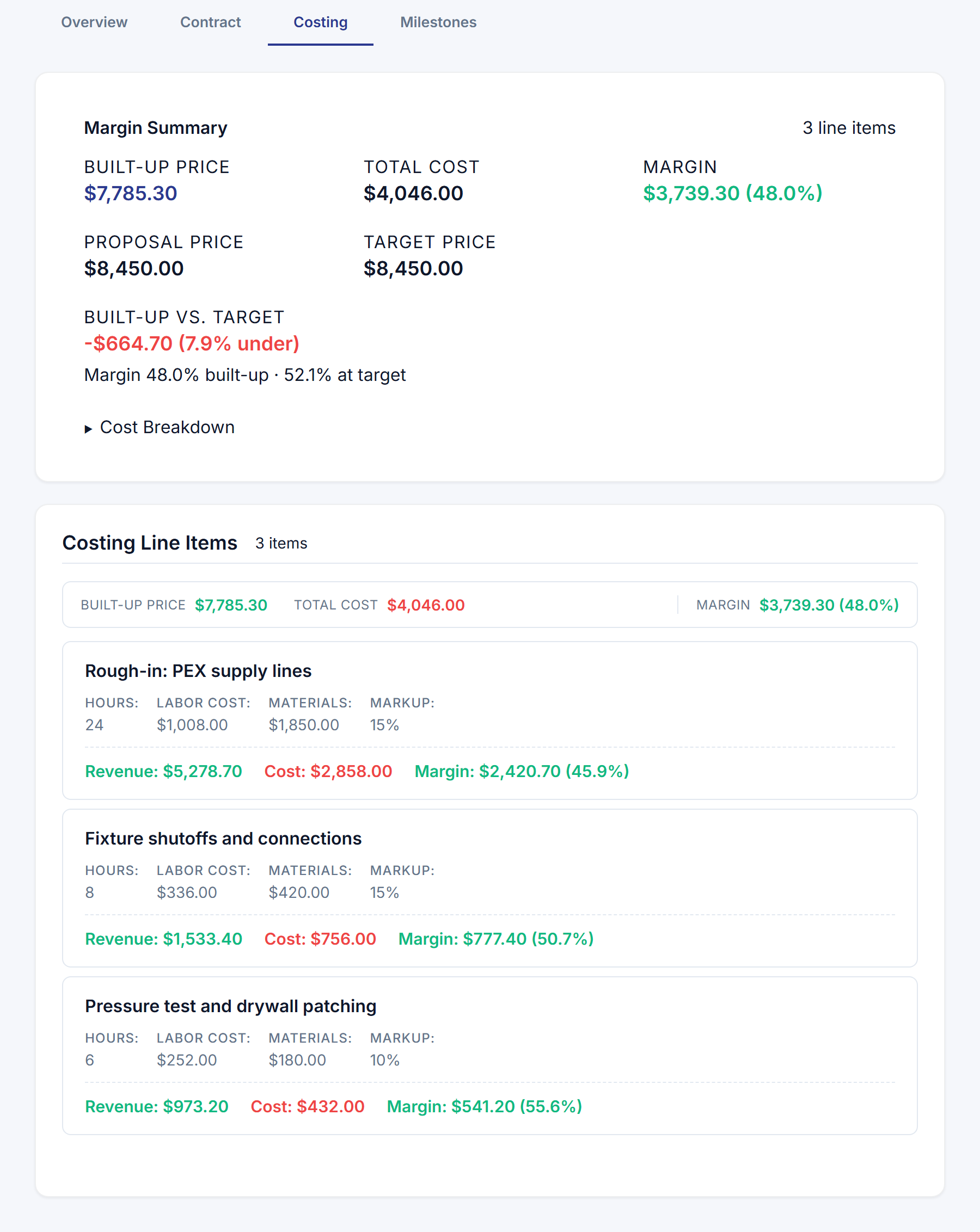
Costing is how you find out whether a job made money, and ideally before it is over. You set your labor rates once, build proposals out of line items that use them, and the job then compares what you estimated against what it is actually costing.
Set your labor rates
Under Settings → Labor Rates, write down each kind of labor you sell — Owner, Skilled Labor, Helper, whatever your crew actually looks like. Each one carries two numbers:
- Cost rate — what that hour costs you.
- Billable rate — what you charge for it.
The gap between those two is where your margin comes from, which is why the product asks for both rather than one rate with a markup bolted on. If your operation is simple, the two can be the same number.
Mark one profile as the default and it is picked for you on new line items.
Rate profiles are kinds of labor, not people. One “Skilled Labor” rate covers everyone doing that work.
Changing a rate never changes the past
Raise your rates and every proposal you have already written, and every hour already logged, keeps the rate it was priced at. The old job stays true to what it was quoted at, and your history does not silently rewrite itself when you put your prices up.
Build estimates out of line items
A proposal is priced with line items, and each one carries:
- Estimated hours at a chosen labor rate.
- Materials cost.
- Equipment cost — typed as a figure, or worked out from a machine’s hours or days at its cost rate using the helper beside the field.
- A markup percentage applied on top of all three.
From those, the product works out the cost, the revenue and the margin for that line and for the proposal as a whole — so you see what you are making before you send it, not after the job is done.
Save the work you quote over and over
Under Settings → Cost Templates, build a template for anything you price repeatedly — a water heater swap, a standard bathroom, a service call. A template is one or more line items with their hours, rates, materials, equipment and markup already filled in.
Applying a template to a proposal expands it into ordinary line items you can then edit. You can apply it with a quantity multiplier — three of the same unit, say — and the materials and equipment scale with it.
A template is a starting point, not a link. Once expanded, the line items are the proposal’s own; editing the template later does not reach back into proposals already written, and editing a proposal does not change your template.
Watch a running job against its estimate
When a proposal is accepted, its line items transfer onto the job as a baseline that never changes. That frozen estimate is what everything is then compared against.
The job’s financials show three columns:
- Estimated — from the baseline.
- Actual — hours logged at the rate they were logged at, non-void expenses linked to the job, and equipment usage at its recorded rate.
- Variance — actual minus estimated. A positive cost variance means you are over budget.
While a job is still in progress there is also a projected figure: what you have spent so far plus what is left of the estimate. That is the number that tells you a job is going wrong while you can still do something about it.
Equipment appears as its own cost column, and only where one side or the other actually has a figure.
Know what “revenue” means here
Two definitions in this product are worth being precise about, because they are the ones people assume wrongly:
- Revenue is cash collected — invoice payments plus income records. Not what you invoiced, and not what the milestones add up to. A job is not profitable because you sent a bill.
- Job cost is only what is tied to that job. No overhead is spread across jobs. When this screen says a job cost you $4,200, that is $4,200 of labor, materials and equipment on that job and nothing allocated to it from somewhere else.
Both are deliberate. A margin figure mixed with allocated overhead cannot be traced back to anything you can act on.
This page describes Cost Modeling & Job Costing. It is written from that feature’s record and covers what has shipped, never what is planned.