
Proposals
Build a priced proposal in a guided wizard, send it, see when your client opens it, and have the job created for you the moment they sign.
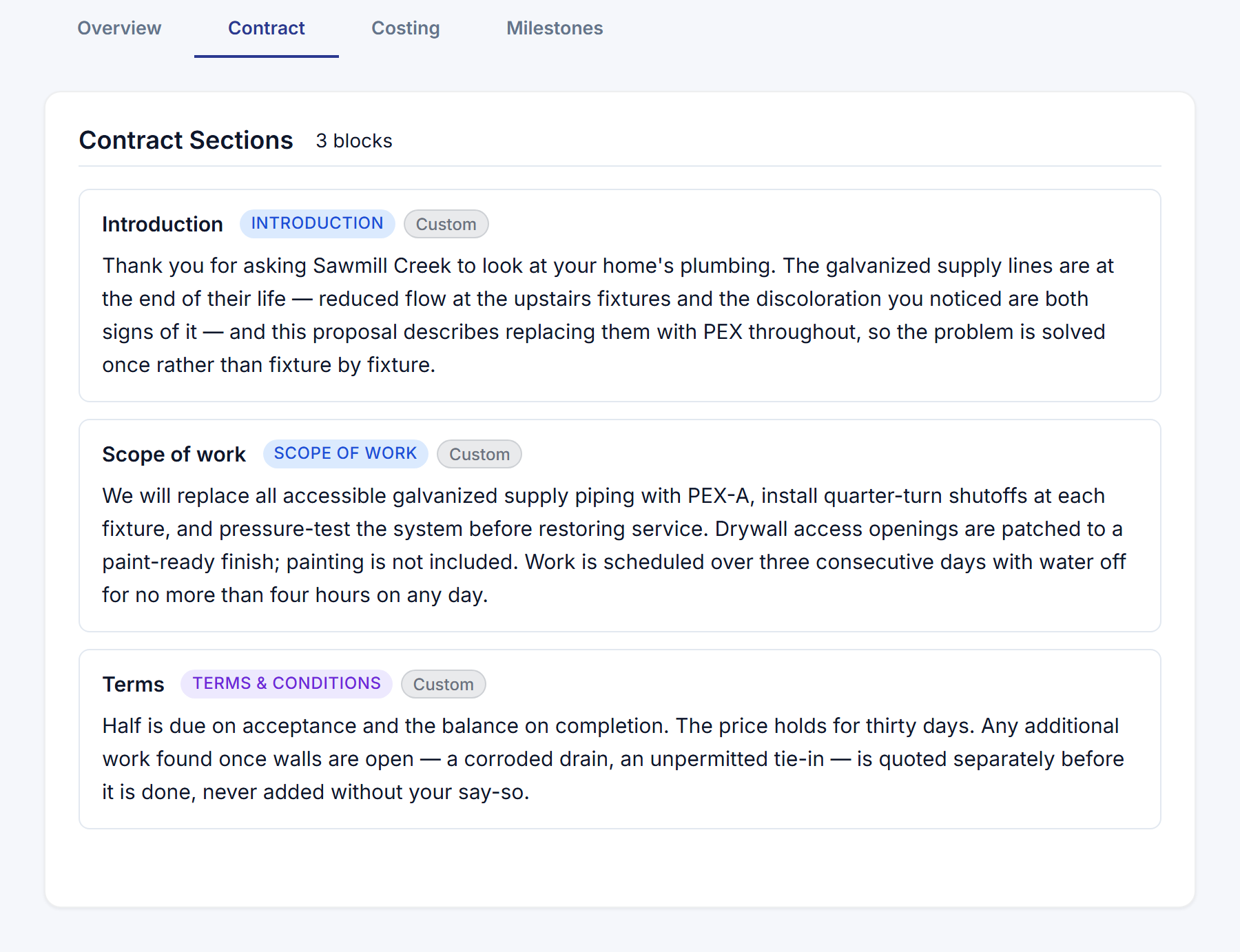
A proposal is the document that wins you the work: the scope, the price, the stages and the terms, in something your client can read and sign without creating an account. When they sign it, the job is created for you with the milestones and the costing already on it.
Write a proposal
Open Proposals and start one. It is a wizard in four steps, and you can leave at any point with Save as Draft & Exit — coming back drops you at the step you stopped on.
Step 1 — who it is for. Pick the client (you can add one without leaving the form), and optionally a title, the kind of work, the service address, a valid-until date and a target price. Valid-until defaults to 30 days out. The client is the only thing you have to fill in to save a draft.
Step 2 — describe the job. Write what the work is, in whatever shorthand you would use in a notebook.
Step 3 — review and adjust. Three sections — the contract wording, the costing line items, and the milestones — which you edit, add to and delete from until they say what you mean.
Step 4 — pricing. Three numbers side by side, and the gap between them is the point of the whole screen.
Understand the three prices
This is the part worth reading twice, because it is what stops you quoting a number you cannot make money at:
- Target price — what you set out to charge, typed in step 1.
- Built-up price — what the line items actually add up to.
- Proposal price — what your client sees, split across the milestones.
Use built-up price makes the built-up total the proposal price in one click and re-cuts the milestones by their percentages. It deliberately leaves the target alone, so you keep seeing the difference between what you hoped to charge and what the work costs — in dollars and as a margin at each price.
If the milestones no longer add up to the line items, the summary says so rather than letting you send a proposal whose parts disagree.
Let the product draft it for you
Describe the job in a sentence or two and the product proposes the contract sections, the costing line items and the milestones. Everything suggested is added straight to the proposal for you to edit or delete — nothing waits behind an accept-or-reject step.
Suggestions come from two places and each is labeled so you know which you are reading:
- From your template library — a match against a cost template you already wrote. These are preferred, because they are your real numbers.
- AI Generated — work your templates did not cover.
Regenerate replaces what the product suggested and leaves anything you edited or added yourself alone.
Drafting needs Professional, because it spends against your monthly AI allowance. On Starter the wizard works identically with everything entered by hand, and the manual path is not a lesser version of the flow — it is the same flow.
Send it and see when it is opened
Sending checks that the proposal is actually sendable first: it needs contract wording, at least one milestone, a total above zero and a valid-until date. The email goes out with your business’s branding and a link unique to that client.
Your client opens the link with no account and no password. They see your branding, the scope, the milestones and the total, and they can download it as a PDF.
The first time they open it, you get an email. After that, every view is counted, and the proposal’s page shows how many times it has been opened and when it was last looked at — which is usually the most useful thing you can know before picking up the phone.
Chase a proposal that has gone quiet
A proposal that has been sent but not answered gets one follow-up email automatically, a few days later. Not a drip sequence — a single “just checking in” with the key details and a link back.
You choose the gap under Settings → Organization (three days by default, anywhere from one to thirty), and you can turn the follow-up off for an individual proposal from its page. A proposal that has been accepted, declined or expired is never followed up. One that has merely been viewed still is, because opening something is not answering it.
Follow-ups are on every plan. An email costs nothing worth charging for.
Get it signed
Your client accepts by typing their name as a signature, entering their name and email, and ticking the agreement box. The acceptance is recorded with the time, their IP address and their browser, so there is a real audit trail behind the signature.
The moment they accept, the job is created for you — Approved, with the title, the description, the kind of work, the line items and the milestones carried across. You do not re-key anything.
They can also decline, with optional feedback, which is worth more than silence.
Revise a proposal you have already sent
Create a revision from any proposal. The new version gets its own link, and the old one is marked superseded — a client who goes back to the original link is told there is a newer version rather than reading a stale price. The proposal’s page keeps the whole version history; the Proposals list shows one row per proposal with a count of its versions.
After a proposal has been accepted, changes are change orders on the job instead: additions and credits you send for your client to acknowledge, with the same audit trail.
Void, delete and expire
- Void works at any stage and is a soft delete — the record stays.
- Delete only works on a draft. Once a proposal has been sent to somebody it can be voided but not erased.
- Expire happens on its own when the valid-until date passes. An expired proposal cannot be accepted; if the client comes back late, create a revision.
This page describes Proposals - Documentation. It is written from that feature’s record and covers what has shipped, never what is planned.