
The number, and what it read last time
Say once what your business measures. The reading goes on the furnace, not the visit — so next winter, last winter's number is beside the box. And an inspection line can ask for a number.
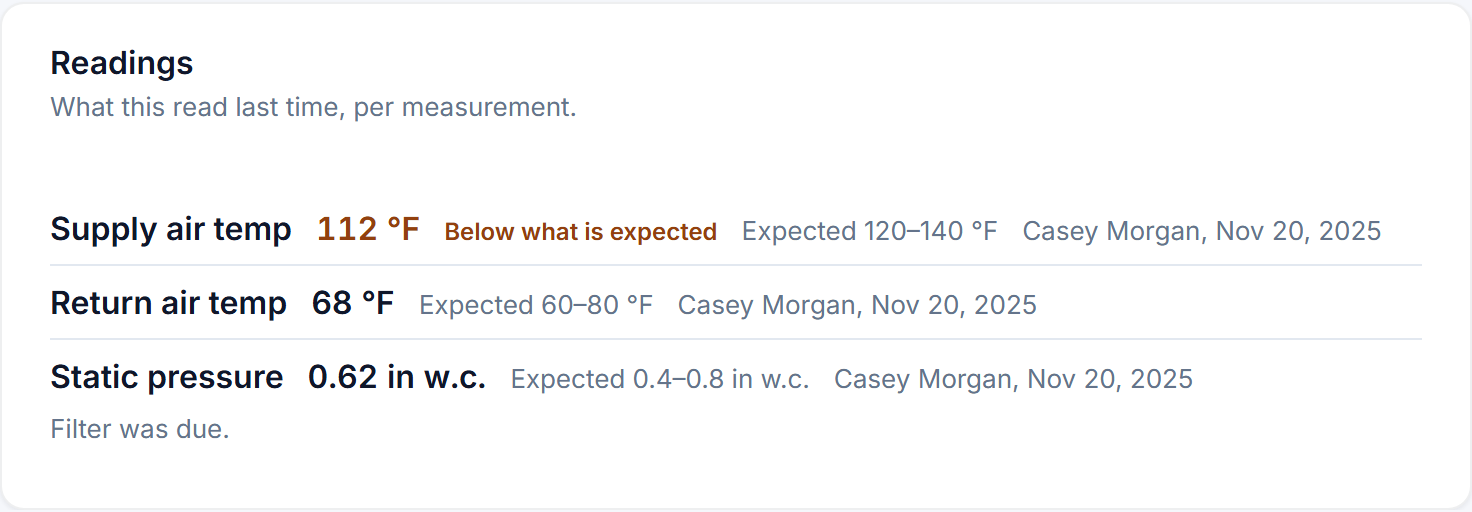
Every trade takes readings. Supply and return air across a coil, water pressure at the main, voltage on each leg, tread depth, oil pressure. Until now they went in a note, if they went anywhere, and a note is not something you can compare against next year.
Say once what you measure. Under Organization → Measurements, name a reading, pick what kind of quantity it is — temperature, pressure, voltage, length, airflow — and the units that belong to that quantity are the only ones offered. Say what you expect it to read, if you expect anything: 68–76 °F, at least 5 MΩ, no more than 80 psi. Then tell each kind of work which readings it takes, and whether each is required. A furnace tune-up asks for three; a drain clear asks for none.
You do not invent units. °F, °C, psi, in w.c., volts, amps, CFM, miles, inches: the list is ours and it is closed, because a conversion factor somebody typed wrong is a comparison that is quietly wrong forever. Two air temperatures on one job are two measurements with two names, not one measurement with a position — so Supply air temp and Return air temp each keep their own history.
The number goes on the thing, not on the visit. A reading names what it was taken on: the customer’s furnace, one of your own machines, or the job itself. Recorded on the job page or from the crew’s own day, it lands on the unit — so the furnace’s page shows what it read last time, per measurement, with what was expected and who took it. Next winter, the technician standing in front of that furnace sees last winter’s number beside the box they are typing into. That is the whole point: one reading is data, two is a direction.
A reading outside what you said to expect is marked and saved and blocks nothing. Finding a bad number is why you took it. Re-read it and the new number stands while the one it replaced stays visible, with who changed it — because which number came first is a fact about the visit.
And an inspection line can ask for a number. A pre-trip or daily check used to be pass, fail or not applicable, so “tire pressure” recorded that somebody had looked. A line can now name one of your measurements and take the reading instead: 18 psi against the 32 you expect. Whether it passed is judged against your range rather than by whoever is holding the gauge, and a critical line out of range costs exactly what a critical fail costs — a defect saying what was read against what was expected, and the machine out of service until somebody fixes it and says so. A measurement with no expected range can never fail; it is a number being written down.
Your machine’s odometer and hour meter stay where they were. Those have their own record, which refuses a reading that goes backwards and is fed by your mileage trips and services — so a line recording in the same unit the machine counts in is refused rather than quietly becoming a second answer.
None of this is a certification. A reading is what a person wrote down and a range is what you typed in; what a number means for the thing it came off is your judgment, and the Terms say so.
On every plan. A reading is a number in our own database.