
Importing and exporting your data
Bring your client list, price book and equipment in from another system, and get any list back out in the same columns.
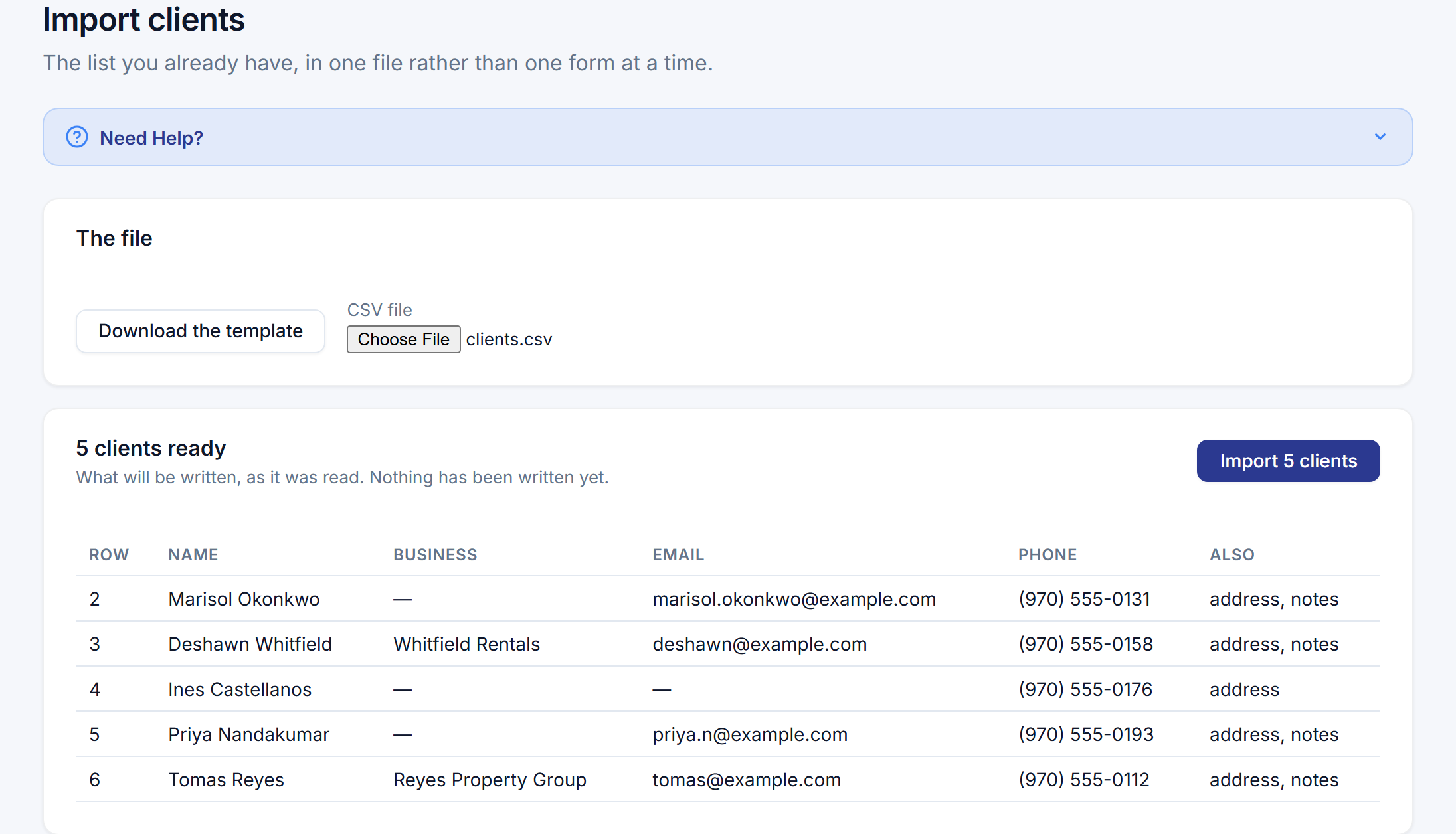
The thing that stops a business switching systems is the filing cabinet — the client list, the units at their properties, the vans, the price book. Nobody is retyping that. Import & export is one page, under Your data, listing every way information comes in and goes out.
Import in three steps
Every import has the same shape, so learning one teaches you all of them:
- Download the template and fill it in. The columns are named and in order, so there is no guessing what the file should look like.
- Upload it. The whole file is checked before anything is created, and if something is wrong you are told the row and the reason — not “import failed”.
- Preview, then commit. You see what is about to be created before it is.
Nothing is created until you say so, and a file that is half right is never half imported.
What you can bring in
- Clients — the list itself, which is usually the thing worth switching for.
- Units — the equipment at your clients’ properties, with their serial numbers and histories.
- Equipment — your own vans and machines.
- Materials — your price book.
- Job types — the kinds of work you do.
- Bookable services — what customers can book online.
What deliberately cannot be imported
What comes in is what exists, not what happened. Clients, units, equipment, materials, job types and services are things your business has. Jobs, invoices, payments and logged hours from another system are things that happened — and importing those would fabricate a history this product would then treat as real, with margins, tax summaries and reports built on top of it.
Your old system’s records stay where they are, as the history. This one starts from the day you switched, and everything it tells you afterwards is something it actually saw.
Get your data back out
Every list exports in the same columns its import template uses, so a round trip works: export, edit in a spreadsheet, import back.
Beyond the lists, Your data also holds the whole-account archive and your accounting exports. Getting everything out is not a support request — it is a page.
Your data is yours. It is on the pricing page and in the privacy policy, and this page is what makes it a fact rather than a claim.
Where to start
Bring your client list is on the Get Started checklist, which is the right first move for a business setting itself up without talking to anybody. Import the clients, and everything else you do afterwards has something real to attach to.
This page describes Import & Export — Switching in an Afternoon. It is written from that feature’s record and covers what has shipped, never what is planned.