
Measurements and readings
Define what your business measures, take readings against the thing measured, and see what it read last time.
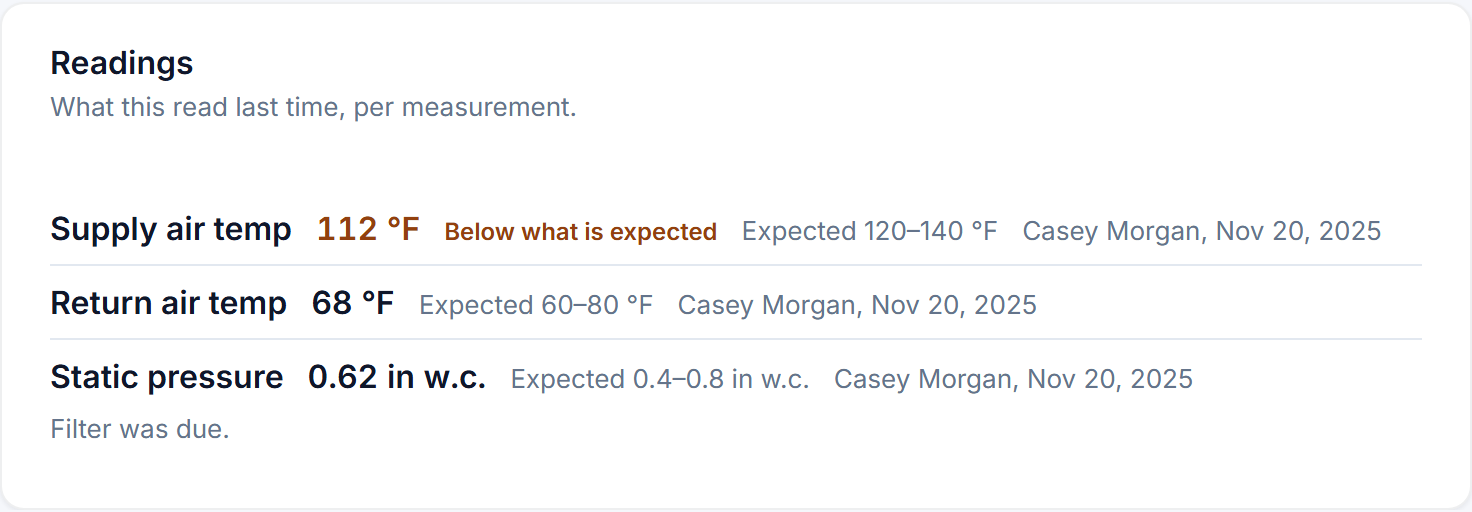
The work this product serves is full of numbers somebody read off something: a supply air temperature, a static pressure, the voltage on each leg, the depth of a trench.
Today those live in a sentence in a note, and the note is the only place they exist — so what did this furnace read last time means opening three jobs and reading prose. A reading is that number with a home.
Say what your business measures
Under Settings → Measurements, define each thing you measure. A measurement carries:
- A name — Supply air temp, Static pressure.
- A quantity and a unit — temperature in °F, pressure in inches of water column. The units come from the product’s own table, so a quantity and a unit can never be mismatched.
- An expected range, where there is a sensible one — 68–76 °F, at least 5 MΩ.
You define these once. Everything that asks for a reading refers to one of them.
Take a reading
A reading names four things: the measurement, the subject it was taken on, the value, and the unit.
The subject is what makes it useful — a unit at a customer’s property, a piece of your own equipment, or the job itself. Recording it against the thing measured rather than against the paperwork is the whole design: a checklist deleted, a template archived or an inspection superseded, and the reading still stands.
You can record one from the job’s own Measurements section, from a checklist step, or from the crew’s phone. All three write the same record.
See what it read last time
Wherever you are taking a reading, the product shows what that subject read last time, and when, or says there is none.
That is the figure the new number means something against. A supply air temperature of 112 °F is just a number; 112 °F against 104 °F last winter is a finding.
Understand the range and the mark
A reading outside its expected range is marked as outside — and that is all it is. It is not an error and it does not hold anything up.
Whether a reading is in range is worked out from the range the reading was judged against, kept with the reading itself. So a report reprinted next year says what was true when the number was taken, even if you have since changed what you expect.
Two things that look the same and are not: what the crew sees while recording is the range now; what a report shows is the range it was judged against. Both are right — one is the instruction, the other is the record.
When a reading is taken again
Re-recording supersedes what it replaced on that subject, and the earlier one stays visible as history. One reading stands per measurement per subject per job.
A job that touched two furnaces has two readings of one measurement, and both are real.
Where readings get asked for
- A checklist step can say take this reading, here, in this order — see Job checklists.
- A job type can name the measurements its work always takes.
- An equipment inspection line can ask for a number — see Equipment readings, service and cost.
In every case the reading itself lives against the thing measured, not against the form that asked.
This page describes Measurements and Readings. It is written from that feature’s record and covers what has shipped, never what is planned.