
Jobs
The record every other part of the product hangs off — the work, who it is for, what was done, what it cost and what it made.
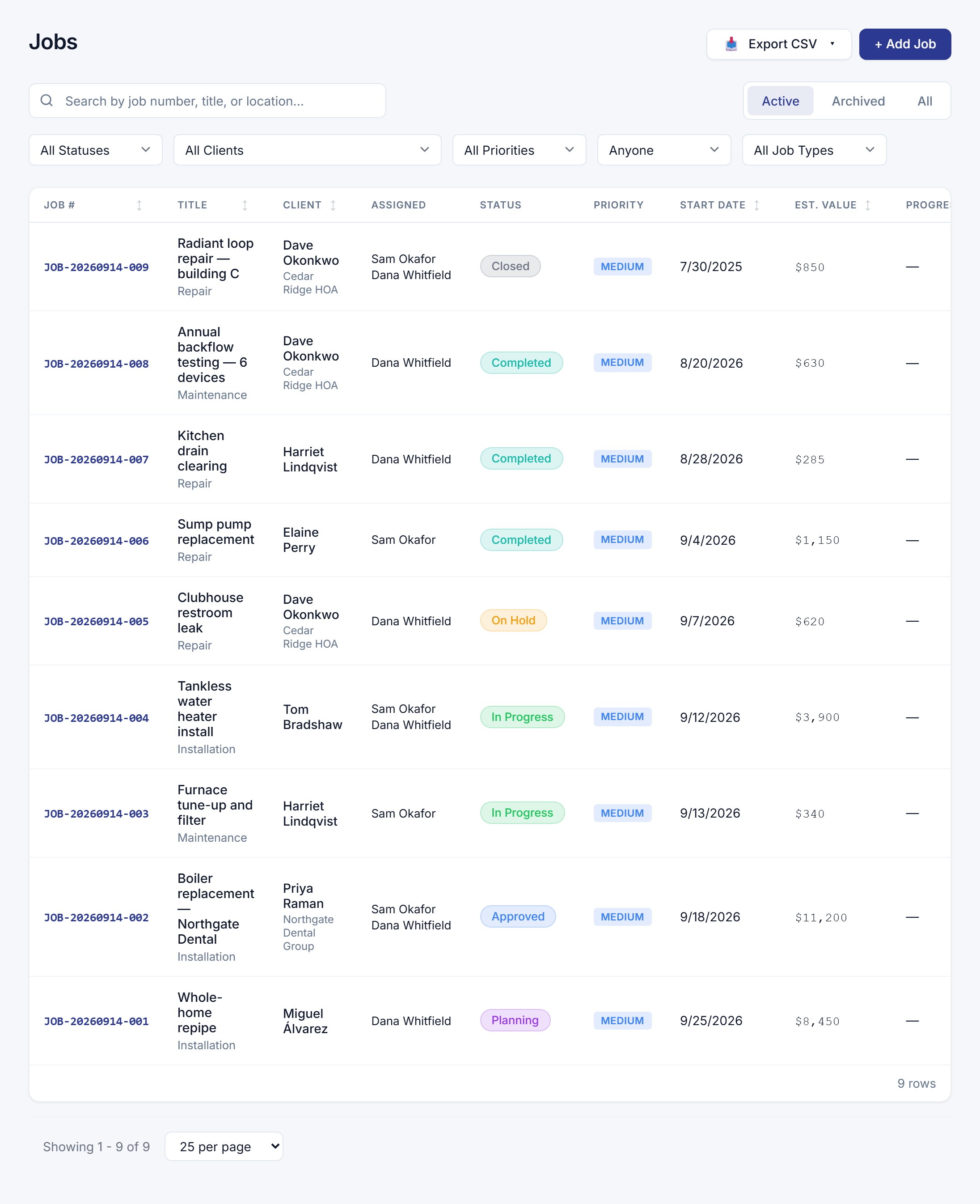
A job is the piece of work you are doing for a client, and it is the record everything else attaches to: the proposal that won it, the time and materials that went into it, the invoice that billed it and the profit left at the end. If you only ever learn one part of this product, learn this one.
Create a job
Open Jobs and add one. Two things are required and the rest can be filled in as you learn it:
- Title — what the work is, up to 200 characters.
- Client — who it is for. You can add a new client without leaving the form.
- Kind of work — see Sort jobs by the kind of work. You can add a new one inline if none fits.
Optionally: a start date and a target completion date, an estimated value, the scope of work, the address if it is not the client’s usual one, a priority of Low, Medium, High or Urgent, and internal notes your client never sees.
Every job gets a job number in the form JOB-20260921-001, generated for you. You can type your
own instead as long as it is not already in use.
Move a job through its stages
A job has six stages, and the status is how everybody knows where it stands:
| Stage | What it means |
|---|---|
| Planning | You are scoping the work or preparing a proposal. |
| Approved | The client has accepted. |
| In Progress | The work is happening. |
| On Hold | Paused for now. |
| Completed | The work is finished; payment or closeout may still be outstanding. |
| Closed | Finished and fully paid. |
You can change the status from the job’s page without opening the edit form. Moving a job to Completed or Closed asks for the date the work actually finished, because that date is what the reports use and today is usually not it.
If the kind of work carries a checklist, the job will not move to Completed until the required steps are answered — see Job checklists.
Find the job you are looking for
The Jobs page searches as you type, and filters to:
- Active — the default, everything not archived.
- Waiting on a checklist — jobs that cannot be finished until somebody answers the remaining required steps.
- Archived.
- All.
Sort jobs by the kind of work
Every job carries one job type — Plumbing, HVAC, Roofing, whatever your trade actually does. It is required, and it is what makes the reporting worth reading: without it, which kinds of work make money is a question nothing can answer.
Manage them under Settings → Job Types, where you can add, rename, reorder by dragging, archive and set the one that should be picked by default. A new business starts with a single type, General Work, so writing the handful that match your trade is one of the first things worth doing — it is what makes the reporting worth reading later.
A job type that jobs are already using cannot be deleted, only archived, so no job is ever left pointing at nothing.
When a proposal is accepted and becomes a job, the kind of work comes across with it.
Write down what happened on the job
The Notes on a job are the running record of the work. Each note has a type — General, Work Performed, Client Communication, Issue or Decision — so you can tell at a glance whether you are reading a decision somebody made or a problem they hit.
Notes cannot be edited or deleted. A correction is another note. That is deliberate: the value of a work record is that it says what was actually thought at the time, and a record anybody can quietly revise afterwards is worth very little in a dispute.
Two things a note can also do:
- Mention a teammate with
@, if they can see the job, so it reaches them. - Go to the client, and their reply comes back into the same thread as a note from them.
Attach photos and files
A job holds photos and documents — before and after shots, a picture of the damage, the signed change order, the permit. They are labeled by what they are, and they appear anywhere the job’s photos are shown, including on a checklist report your client receives.
Storing files needs Professional. On Starter everything else about a job works exactly the same; what you do not get is somewhere to keep the picture.
Archive a job you are finished with
Jobs are archived, never deleted. Archiving takes the job out of the active list and keeps everything attached to it — the time, the expenses, the invoices, the notes, the photos. Show archived on the Jobs page brings them back into view, and you can unarchive at any time.
Nothing in this product hard-deletes a job, because the one time somebody needs a three-year-old job record is the one time it would be gone.
This page describes Job Management & Job Types. It is written from that feature’s record and covers what has shipped, never what is planned.