
Job checklists
Write down the steps a kind of work always needs, have the crew work them in order, and stop a job closing until the required ones are answered.
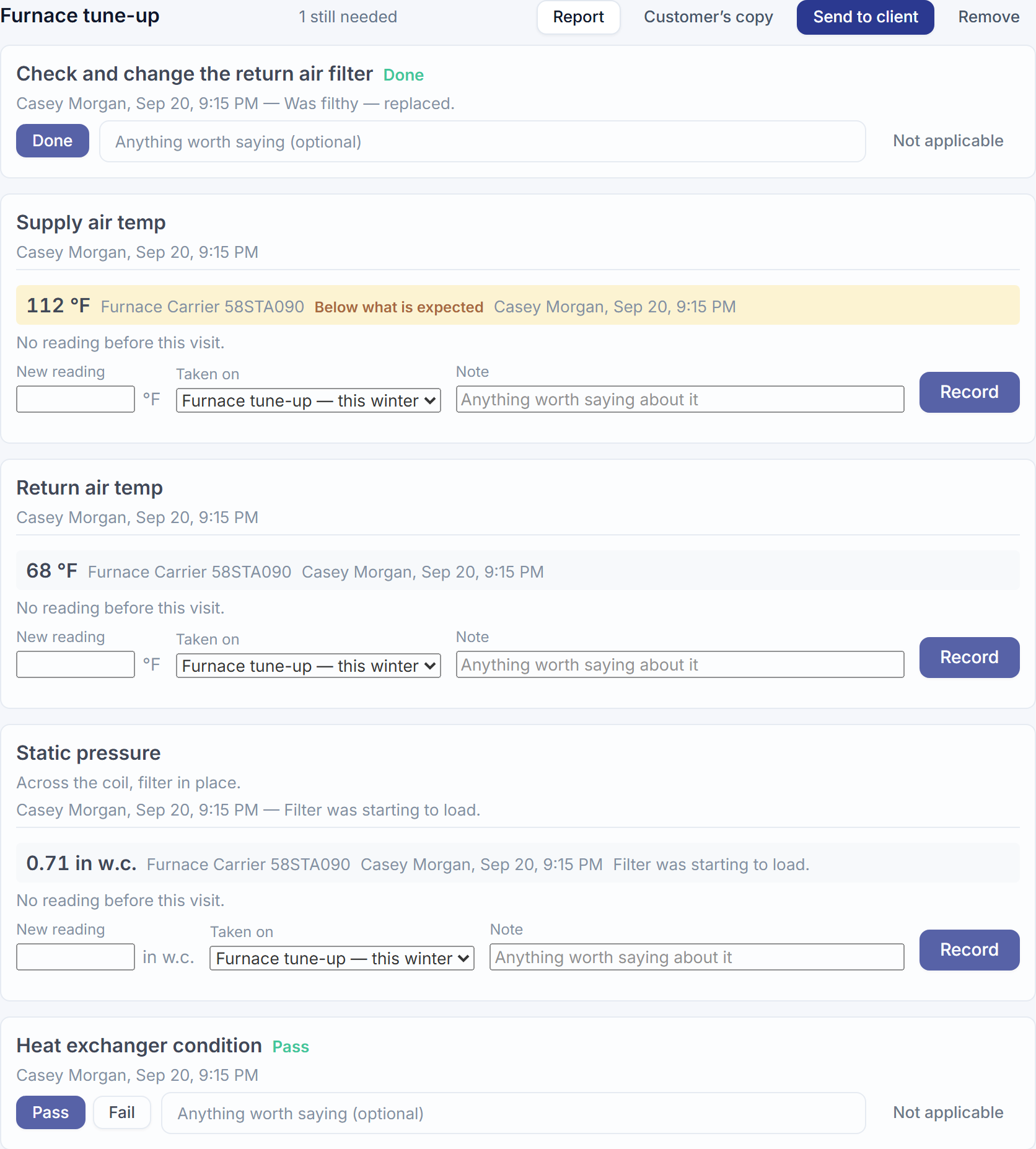
A checklist is the plan for a job and the proof it happened. You write the steps once for a kind of work, every job of that kind gets them, and the job will not be marked done until the required ones are answered — so the record is complete before anybody has left the property.
Write a checklist for a kind of work
Go to Settings → Checklists and choose New checklist. A checklist needs a name, and can have a description if the name is not enough on its own.
Then add the steps, in the order the work is actually done. Each step has:
- The text — what you want done. Check the gas pressure, Photograph the panel before you close it.
- What it asks for — see Choose what each step asks for.
- Required, if the job should not be marked done until it is answered.
- Internal, if your customer should never read about it. An internal step is worked and required exactly like any other; what changes is that it is left off the copy your customer gets.
- A note to the crew, if there is something useful to say — where the valve is, what to watch for.
Drag a step by its handle to move it, the same way you reorder proposal line items.
Tick Customers see the completed list if you want the finished list on your customer’s own page and available to send them. Leave it off and the list stays inside your business.
A checklist has to have at least one step, every step needs text, and a Choice step needs at least two options. If something is missing, the refusal names the step it is about — you will not be left guessing which of twenty is wrong.
Retiring a checklist
Checklists are archived, not deleted. Archiving stops a checklist being given to new jobs and changes nothing about jobs that already have it — their list stays exactly as it is, and so does everything already answered on it. Show archived on the Checklists page brings them back into view.
Choose what each step asks for
Every step is one of eight kinds:
| Kind | What the crew does |
|---|---|
| Tick | Marks it done. The plainest step, and what most lists are made of. |
| Measurement | Takes a reading you track over time — see Take a reading from a step. |
| Number | Types a figure that is only about this visit. |
| Text | Writes something down in words. |
| Choice | Picks one of a list you wrote. |
| Condition | Judges it pass, fail or not applicable. |
| Photo | Takes a picture. |
| Signature | Signs on the screen. |
A number and a measurement are both numbers, and the difference is whether the number has a life after this job. A measurement is something you track — a temperature, a pressure, a resistance — with a unit, an expected range, and a history against the thing it was read off. A number is a figure about this visit only: how many filters you left, what the customer’s own meter said, how many feet of cable you pulled. If you would ever want to compare it with last time, make it a measurement.
A Signature step is always required. There is no useful sense in which a checklist asks for a signature optionally, so the box is set for you — if you do not want a signature, remove the step.
A Photo step exists on every plan, and keeping the picture needs Professional. On Starter the step is still there and still required, and it says so on the screen: mark it done and say what you saw.
Attach a checklist to the kinds of work that use it
A checklist reaches a job through the job’s kind of work. On Settings → Job Types, open a job type and choose its checklists. A job type can carry any number of checklists, and a checklist can be on any number of job types.
From then on, a new job of that kind gets those checklists when it is created, as a copy of each one as it stood at that moment. Editing a checklist afterwards changes what new jobs get and leaves jobs in progress alone, which is what you want — a list somebody is halfway through should not change under them.
Two things follow from that, and both are deliberate:
- A job created before you added a checklist to its job type does not get it, and is not held up by it.
- Making a step required later does not go back and hold up jobs that already exist.
Work the list on a job
The office sees the whole list on the job’s page. The crew sees it on My Day, on the job they are working, and their card shows how many required steps are still needed before they tap in.
Each step is answered where it is: ticked, typed, chosen, judged, photographed or signed. Any step takes a note, whether it asks for one or not, because the useful thing somebody has to say is usually not on the form.
Every answer records who gave it and when, and changing an answer records the change. Nothing is overwritten quietly.
Not applicable counts as answered on any kind of step. If the step was required, you are asked to say why — not applicable with no reason is the answer that means nothing.
If an answer fails to save — no signal in a basement, a dropped connection — you are told it did not save and what you entered is kept.
A job whose kind of work carries no checklist shows no list to the crew at all. The office sees one line saying the job carries none, with an offer to suggest one for this visit.
Take a reading from a step
A measurement step does not hold the number itself. It says take this reading, here, in this order, and the reading is kept against the thing it was read off — a unit at your customer’s property, a piece of your own equipment, or the job. That way the history belongs to the thing measured, so removing a checklist or archiving a template never loses a number.
When somebody answers a measurement step they choose what it was read on, from what the job already touches. A job that touches only itself asks nothing and shows no choice.
The step also shows what that thing read last time, and when — the figure the new number is compared against — or says there is none.
A reading outside its expected range is marked as outside. It is not an error and it does not hold anything up: finding a problem is why somebody looked.
The job’s own Measurements section and a checklist’s measurement step are the same number in two places. Record it in either one and the step reads as answered. The two sections load separately, so after recording in one you may need to reload the page for the other to catch up — the record is right, the screen is a moment behind.
A note on a measurement step goes on the reading, so one number has one note wherever you read it. Every other kind of step keeps its note on the step.
What a required step stops
A job with an unanswered required step cannot be marked Completed. That holds from every direction — the crew’s control, the office’s job form, and anything else that moves a job.
The refusal names what is left: up to three steps, then and N more. On a phone the crew’s Completed option is not offered at all, with the reason shown, so a button never promises something the server will refuse.
A required measurement step with no reading counts as unanswered. A reading that fell outside its expected range counts as answered.
Required means required to close, and nothing else. No step of any kind stops a job being created, scheduled or worked. A job carrying no checklist is not held up at all.
To see what is being held up, the Jobs list has a Waiting on a checklist filter. It shows unfinished jobs only — a job finished over an override has left the queue, and its own page is where that reason lives.
Finish a job anyway
Sometimes the work genuinely cannot be finished: the customer sent the crew away, the part did not arrive, the unit was inaccessible.
An owner or manager can finish the job anyway from the job’s page. Saving it as Completed brings up Finish this job anyway?, which asks why. The reason is required, up to 500 characters, and a blank one is refused exactly as no reason would be.
What happens then:
- The job is marked Completed.
- The checklist is not ticked. The unanswered steps stay unanswered and stay visible, because what was actually done is the point of having asked.
- The job’s page gains Finished with the checklist unfinished, showing the reason, who gave it, when, and which steps were outstanding at the time.
The crew have no override. Where their Completed option is missing, the page tells them the office can close it — an owner or manager, with a reason.
Removing a checklist from a job
An owner or manager can remove a checklist from a job, and the reason is required. Removing it lifts the hold. What was already answered stays answered, and any reading a step prompted stays on the job — what goes is the requirement.
Send the finished list to your client
On the job’s page, a checklist offers Report: the finished list as a PDF with your business’s name and logo, the job, the date, who did the work, every step with its answer and note, and the photos. It is the first document in SMG Tools to carry a photograph.
Where you marked the checklist Customers see the completed list, two more options appear:
- Customer’s copy — the same document with your internal steps left out. It downloads so you can read what your customer will get before you send it.
- Send to client — emails the customer’s copy as an attachment, with an optional message. The send is recorded on that client’s communication history like any other.
The customer’s copy drops internal steps silently: no gap, no count, no line saying something was left out.
Both options are on the job’s page and are for the office only. The crew are offered neither, because what a customer is told about a visit is not a decision for a driveway.
A measurement step reads on the report as the measurement’s name, its value and unit, the range it was judged against, and a mark if it fell outside — all four taken from the reading as it stood when it was recorded, so a report reprinted next year says what was true at the time.
A step nobody answered still appears, saying so. A half-finished visit should not read as a complete one.
A few things the report will not do:
- A list nobody has answered is refused rather than produced empty: Nothing on this checklist has been answered yet, so there is no report to send.
- A list where everything answered is internal is refused in its own words: Everything answered on this checklist is marked internal, so the customer’s copy would be empty. The work was done and the record exists — it is all the part you keep to yourself.
- A picture that cannot be fetched is left out rather than failing the report. The words are the part that matters.
The report records what a person answered and what a person wrote down. It does not certify anything, and a reading inside its range is not a finding that anything is serviceable.
On your customer’s own page
Where the checklist is marked customers see it, the finished list also appears on that client’s page, under What was done — what was asked, what was answered, the numbers with the range each was judged against, and the pictures.
Turning a checklist’s visibility off means today, including for work that finished last year. The page reads the setting as it stands, so a customer who had a link to a visit stops seeing it once you turn it off.
Let the product draft the steps for you
Rather than writing twenty steps from a blank page, describe the kind of work in a sentence and let the product propose the list.
On Settings → Checklists, choose to suggest a checklist and describe the work — a seasonal furnace tune-up on a residential gas system. What comes back is ordered steps with a kind and a suggested required flag on each, which you then edit, reorder, remove from and save through the ordinary editor.
Nothing is saved until you save it. A suggestion is a draft and the panel says so. There is no path that creates a checklist you have not seen.
Where a suggested step wants a measurement you already have, it names it. Where it wants one you do not, it proposes one — a name, a quantity, a unit and sometimes an expected range — and creates it only when you press Create on it. A suggested range is a proposal and is labeled as one; the product does not hold itself out as knowing what a correct reading is for your trade.
A suggestion will never mark a step internal. That flag decides whether your customer reads about work they paid for, so you tick it or it stays off.
You can also ask for one on a job that carries no checklist, from that job’s own description and kind of work, and accept it onto that job alone. It holds up that job, reaches no other, and no customer sees it — because nobody has decided one may. If you want it every time, the panel says where to save it as a checklist.
Suggesting steps needs Professional, because it spends against your monthly AI allowance. The remaining allowance is shown before you ask, and asking spends it whether or not you keep the answer. On Starter the panel says so and offers nothing that would fail — writing the steps yourself produces a checklist that behaves identically.
Who can do what
| Owner | Manager | Field member | |
|---|---|---|---|
| Write and edit checklists | Yes | Yes | No |
| Attach them to job types | Yes | Yes | No |
| Answer steps on a job | Yes | Yes | On a job assigned to them |
| Download or send the report | Yes | Yes | No |
| Finish a job over an unfinished list | Yes | Yes | No |
| Remove a checklist from a job | Yes | Yes | No |
A field member who asks for the Checklists page is refused, and so is one who tries to answer steps on a job that is not theirs.
What each plan includes
Checklists themselves are on every plan — writing them, attaching them, working them, the gate, the override, the report and your customer’s page. None of that is metered and none of it is gated.
Two parts need a paid plan, and both say so where you meet them:
- Keeping a photo needs Professional. On Starter a photo step still exists and is still required; the picture is not stored.
- Suggesting the steps needs Professional, because it spends your AI allowance.
One part needs Crew: the crew’s own view of the list on My Day, because inviting field members at all is a Crew capability. On Starter and Professional the list is worked from the job’s page.
This page describes Job Checklists and Forms. It is written from that feature’s record and covers what has shipped, never what is planned.