
Route planning
Turn a day's stops into a driven order with real arrival times, so you know when the crew reaches each door and when they are back.
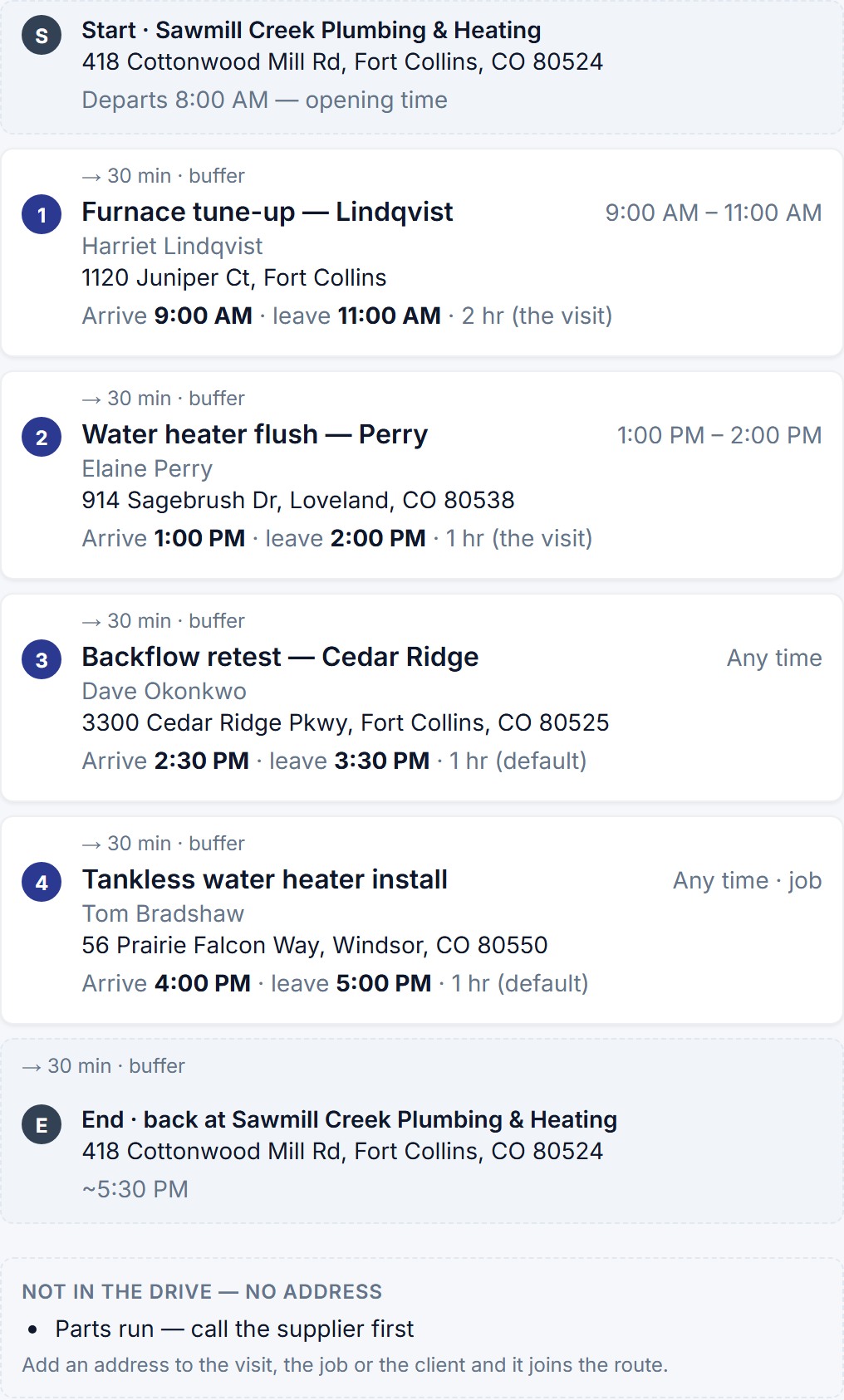
The product already knows everything a route needs — who is going where, the addresses, the windows you promised — and until now it never drew the line between the points.
A route is the day as a drive: which order, how long each leg takes, when the crew actually reaches each door, and when they will be back.
Build the day’s route
A route is one person, one day, built from the stops already in their lane — the visits and the jobs that carry an address.
Open the plan for that person and date and the stops are put in a sensible driving order, with a planned arrival at each.
Pin what cannot move
Some stops are fixed: a window you promised, a customer who is only in at eight. Pin those and they stay where they are while everything else is arranged around them.
That is what makes the plan usable rather than theoretical. A route optimizer that reorders the one appointment you committed to is worse than no optimizer.
Read the arrival times
Each stop shows when the crew should reach it, and the last one shows when the day ends.
That figure is what lets you answer a customer honestly on the phone — and what tells you a day has one job too many in it before anybody sets off.
Watch it against the real day
As the crew moves through the day — on their way, arrived, working, finished — the plan is measured against what is actually happening, so running behind shows up on the board rather than arriving as a phone call.
See Assigning work and the day board.
What the crew gets
The crew sees their stops in route order on their phone, with a map link for each. They do not plan the route; they drive it. See The crew’s phone.
What it costs
Route planning needs Professional with maps enabled, because working out the driving between addresses is a call to a mapping provider that costs per request.
Without it, the day board still shows who is going where — what you do not get is the order, the leg times and the arrival estimates.
This page describes Route Planning & Optimization. It is written from that feature’s record and covers what has shipped, never what is planned.